Saturday, 29 March 2014

GULLFEST 2014 - Part 3 - Fjord and Tundra Birding


One thing that I will always remember from Varanger is how you don't just get a handful of a single species...you get a very impressive number! Living in Lancashire and North Wales, away from most Purple Sandpiper populations, it was a real joy to be around such fantastic numbers of Purps. I would estimate over 600 Purple Sandpipers seen. Not only was there a great number, but they were also remarkably tame. We had a fantastic stop at Ekkerøy being less than 5 metres away from a feeding flock of 180 Purps.

Also along the coast were up to two White-tailed Eagle. Having been in Sweden and Scotland several times, I am certainly no stranger to White-tailed Eagles, but every time you see one 'eclipse the sun', they make an amazing impression!

Also, whilst birding as many bays as we could, Tormod picked up a very distant Diver sp but lost it almost instantly which was frustrating. I scanned and scanned as hard as my eyes would stretch and within 5 minutes I picked it up again. It was strikingly pale headed with a strange 'custard' hue. It soon became apparent that it was a White-billed Diver (a lifer!) and it proved hard to do, but we eventually got everyone onto it. Even though it was over a mile away, it still left an impressive impression on me!


Moving around across Varanger, we went through some incredible habitat or should I saw lack of habitat! The high tundra at this time of year was just a white sheet as far as the eye could see with 1m deep snow all around. Every so often, the snow would come in and it would be almost impossible to see the horizon which was quite unsettling! Anyway, it didn't take too long before we came across several grouse flocks. Closer to the coast, these proved to be Willow Grouse with their white lores and chunkier structure, however closer to the top, we stopped a single bird in a bush...this seemed pretty chunky but being a female, it was hard to ID due to both Ptarmigan and Willow Grouse have white lores in females. Suddenly some birds took flight and after a few opportunistic record shots, I was very pleased to see the black lores of male Ptarmigans! A really nice flock of 15 birds. What the bird in the bush was, we're not entirely sure given the chunkiness and the sitting in a bush. I wonder if there are ever mixed flocks?

It was also really nice to observe up to 400 Reindeer throughout the trip. Beautiful animals and surprisingly small!

The resounding memory of arctic tundra has to be 'white!'. They was incredible amount of snow which made travelling, walking and birding all the more novel.

Wednesday, 26 March 2014

GULLFEST 2014 - Part 2 - Seabirds of Hornøya & Ekkerøy

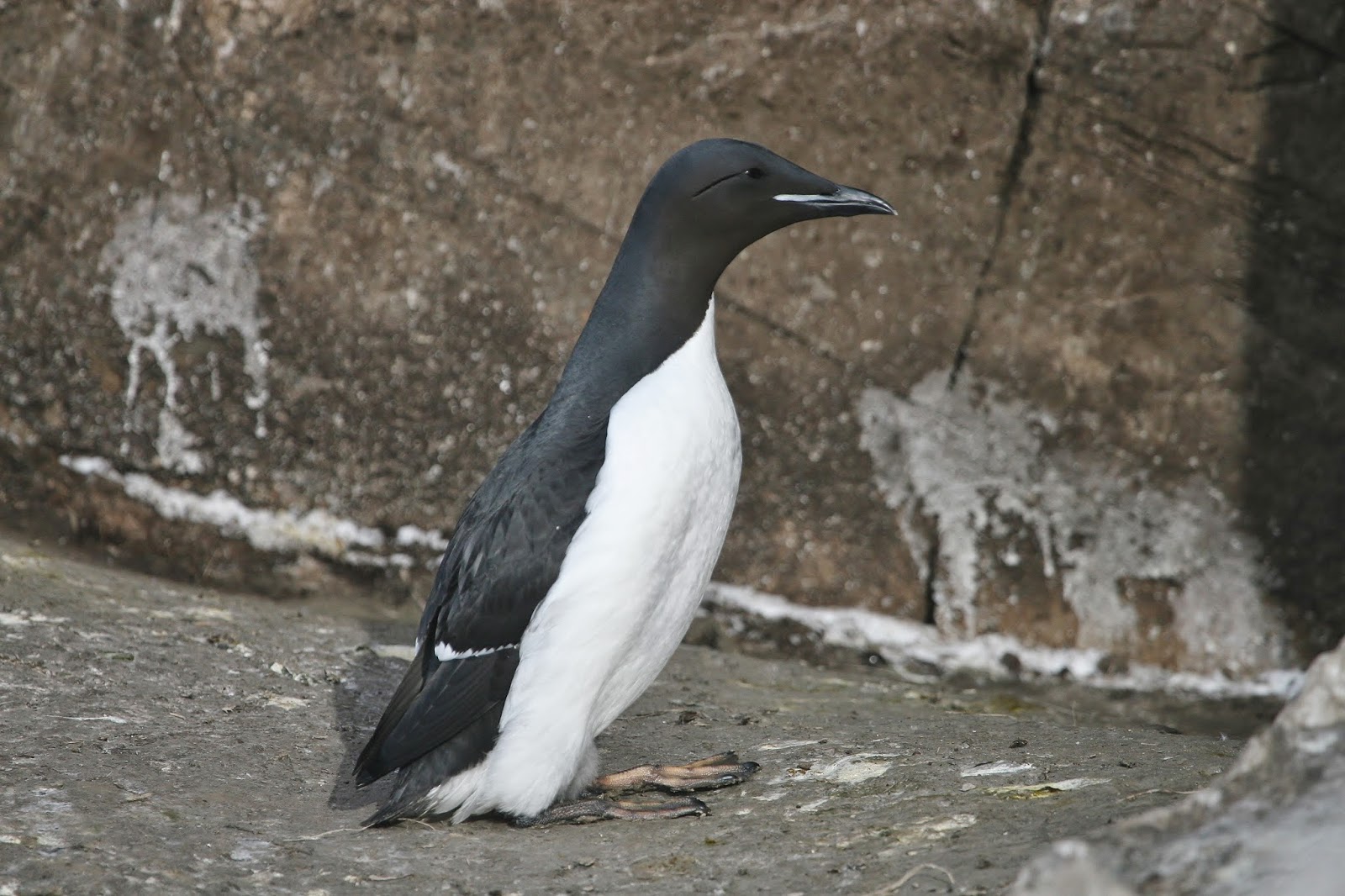
Brunnich's Guillemot - One of the coolest lifers of the trip. Great to see so many. While there are 'only' 500-600 pairs breeding on the island of Hornøya, the non-breeding flocks on the Varangerfjord are something out of this world with several thousand seen (mainly 1st summer/non-breeding plumage types.) While Common Guillemots are usually pretty showy on the island, Brunnich's generally nest in more inaccesible places, however the above and below bird put on quite a show and strutted around like a little penguin at point blank range.
Really clean flanks on Brunnich's compared to Commons (which is even more obvious with the heavier flank and belly markings of hyperborea Guillemots),
The white bar on the secondaries is more broad on in the inner secondaries, but unlike Razorbill, the Brunnich's wing bar tapers as it gets to the outer secondaries so it us more of a comma shape.
The number of breeding Puffins on Hornøya is ridiculous at about 15,000 pairs! Got fantastic views of lots 'playing' in the snow and then having c7000-8000 circling above our heads.

It was great to see breeding plumage Shags again and even more curious to see them in the snow. Really lovely colour tones coming through with the interesting light reflections.
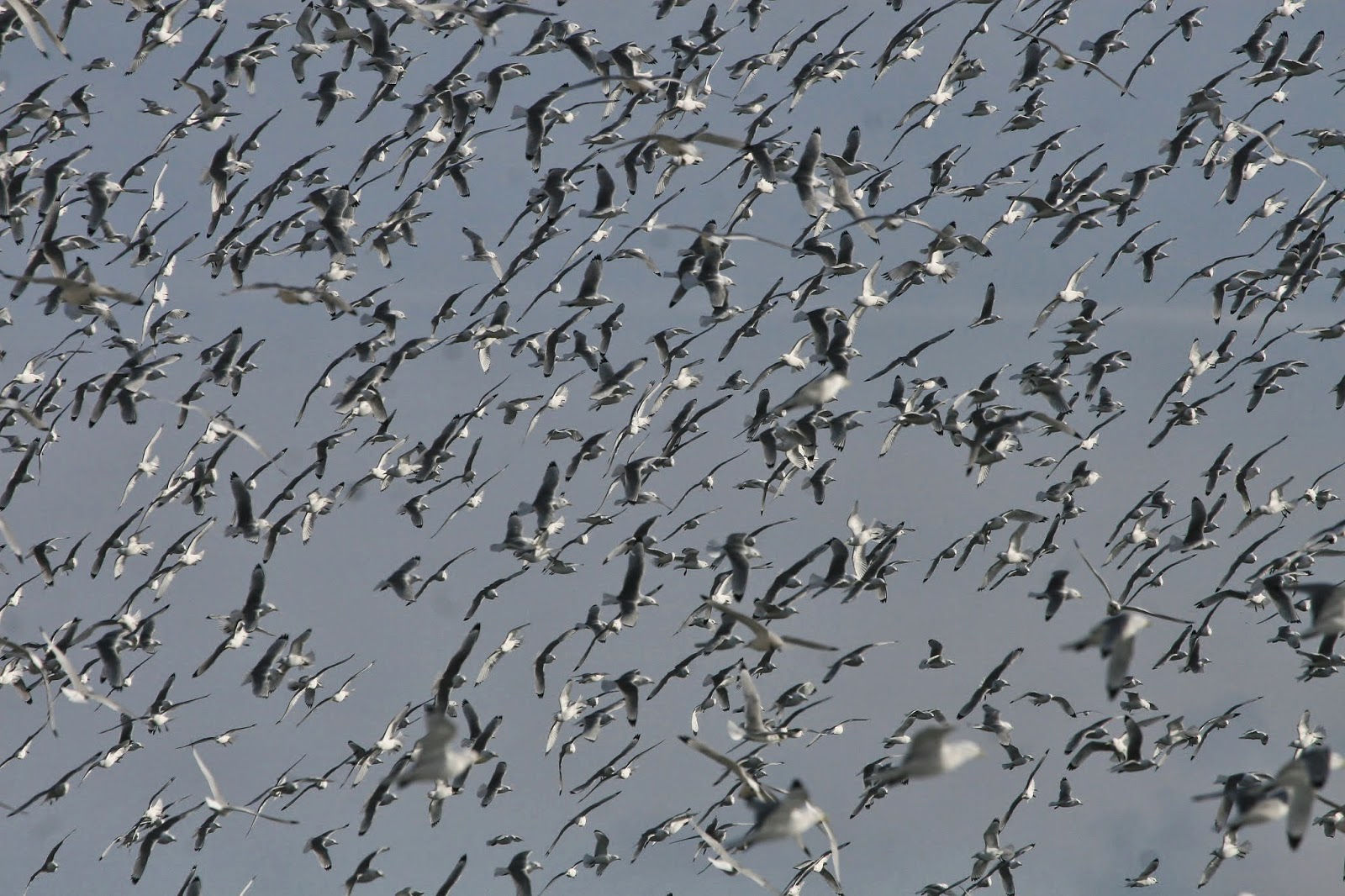
While there was a fantastic population of Kittiwakes on Hornøya and pretty much every coastal building with ledges on the Varangerfjord, the colony at Ekkerøy was superb! A ridiculous number that would flush together from the cliffs as Ravens patrolled.


Beautiful birds when you get a proper chance to look at them.
German birder Jörg Kretschmer showing the edge of what is possible with digiscoping....flight shots in a seabird colony with a hand held scope! So amazing to watch! He even showed us a shot he took of a flying Small White butterfly! How is that even possible?! 

hyperborea 'Arctic' Guillemots
I would say that Brunnich's, being the one lifer from the seabird colonies was the best, but I was very interested in the Common Guillemots. They are of the race hyperborea, at least the identifiable ones were. On the paler end of the scale, they are hard to split from the Southern race of Guillemot that breed in England.

The above two and single below photos show individuals at the high end scale of hyperborea. The vast majority have some heavy barring on the flanks, but I noted at least 20 individuals with markings quite as heavily barred as the above birds. Some had a couple of fleckings in the breast, but the above birds were fantastic! I also noted that the dark birds were lacking a wing bar on the secondaries which accentuated the darkness.
In addition, all of the really dark birds appeared to be Bridled that I saw. The split in the colony was about 50/50 though between Bridled and non. I wonder if the non-bridled birds can show up as this dark?
I noticed an awful lot of Guillemots on Hornøya having orange legs. The same applied with Brunnich's with 50% of Brunnichs' feet observed were orange...another possible feature of northern birds perhaps? I'll have to scrutinize UK birds from now on.
As previously mentioned by Martin Garner, he noted spotted on the otherwise white underwing coverts.  I only got a chance to scrutinize c10 and I wouldn't say this was a standardized feature throughout as several seemed all white.

As previously mentioned. The flank streaking was extraordinarily variable with several Guillemots looking rather pale which occasionally made picking out the clean Brunnich's more difficult.

Very interesting learning in a fantastic place!

GULLFEST 2014 - Part 1: Pasvik Taiga

So, I've just got back from GULLFEST and what a time I had! I will do a few blog posts splitting them up into obvious groups.
Jonnie Fisk and I were invited up to arctic Norway in Varanger by Tormod Arundsen to represent Next Generation Birders at the event. It was a huge honour to be invited as it's a place I've always wanted to go to, however never actually thought I'd ever go!
I am unbelievably grateful to Tormod for the invite and I can't thank him enough for the opportunity!
We flew up to Kirkenes airports after changing at Copenhagen and Oslo (with a night in Oslo) and got picked up by Tormod's wife Elin. We then drove an hour and a half to a 'electricityless' cabin deep in the Pasvik Taiga forests.
After arriving to -9oC and heavy snow on the ground, it was quite astonishing that the very first bird we saw on the car journey was a HAWK OWL! It was a cracking bird sat on top of a pine tree (the above bird was from later on in the trip!)
Also seen from the car was an awesome flock of 15 Willow Grouse which were great to see and very educational. The females are pretty difficult in winter plumage as they're very similar to Ptarmigan, except for a chunkier bill and stockier body. The males are again all whit, but have red comb above the eye and white lores which distinguish them from Ptarmigan. Although not split from Red Grouse, it was great to see this new plumage.
In addition, something I was hoping for, but didn't expect what to be along the edge of the Pasvik river and see the Russian border on the other side with lots of observation towers looking back at us! Being only 40-50m away from the border at one point, it was so close to being a 'Country Tick!'
Arriving at the cabin, we met up with fellow 'Gullfesters': Hans Larsson (Artist and Gull Expert), Richard Crossley (Crossley ID Guides), Graham White (RSPB Chief Wetland Ecologist) and his wife Jackie, Anders Maeland (Birding Norway tour guide) plus the main man himself Tormod (Biotope).
We all gathered around the active feeding stations to watch all the incredible birds including the above Coues's Arctic Redpoll (1 of 3 but only 1 male) which was a lovely lifer and fantastic to watch. The male was like a little snowball!
Probably the most obvious spectacle was a crazy number of Pine Grosbeak with up to 20 around the feeders. There were about 8 gorgeous adult males in total with several 1st winters and several female types.

The above individual was a superb bird that was unbelievably tame and the two shot above are how they look on the memory card...no cropping needed! This bird had no tail which made for a strange flight shape!
I couldn't get over just how big the Grosbeaks were. I thought they'd be like a Hawfinch but they're as big as a Redwing if not bigger! With sun in the air too, the males were sat in trees singing away almost constantly. Absolutely magnificent!

While the obvious spectacle was the pure number of Grozzers, there was a small handful of Siberian Tits that came in often to feed. These really stole my heart and until the very last day, this were my favourite bird of the trip (I'll explain why that changed later!)
Willow Tits in Varanger are remarkably interesting. For starters, this species is my favourite UK resident, so it was great to see. Not only this, they are a different race. borealis is the main race up in the arctic circle which is fantastically pale. Even paler still is uralensis which is race that we saw quite often. Interestingly though, it is quite hard to pin down what the birds at this cabin were. The slight warm tones lead me to believe borealis, however are the warm tones too extensive? Siberian Tit x Willow Tit hybrids have been recorded up there, so maybe we were experiencing non-pure Willow Tits? Either way...what a beautiful bird!
We also had several Northern Bullfinch, Great Tit, Great Spotted Woodpecker and the amazing grey Red Squirrels visiting the feeders.
Our first night of the trip saw up in a cabin that had no water or no electricty and just a fire. This made for a great ice breaker. However at -17oC at night, we had to break the ice a lot! Around 9.30pm, we all went onto the middle of a frozen lake outside the cabin to watch the Northern Lights. This is my first time and it is pretty magical! The activity was quite low whilst we were in the arctic, but still bloody amazing! I can't begin to imagine what it's like when you can even see it during the day! Waking up the following morning, it was -25oC which really sorts the men from the boys!
Camera batteries dying after 30 minutes, walking inside and your optics condensate and then freeze over, getting ice in your nose and struggling to breathe whilst breating on your scarf and that gets covered in frost! An amazingly unforgettable experience!
Whilst on the way back up to Kirkenes to get the Coastal Express ferry to Vardo, Richard spotted what he thought was a Siberian Jay flying across the road

Later on in the trip, on the way back to the airport, we came across a Hawk Owl...before long it took flight and was joined by a second owl. The started fighting in the air and circling around like corvids mobbing something! It was quite an amazing sight! What fantastic birds!

Generally speaking, the rest of the trip is pretty coastal, but for now, I thought a taster of Taiga forest was like as I've said since I was a small child that Taiga Forest in winter is literally the absolute dream habitat for me to visit.

Tuesday, 11 March 2014

Keeping your whites, 'brilliant white'


Recently bought a camcorder as 'videograbbing' after digiscoping has always been something I've wanted in my arsenal whilst out birding.
My recent attempts at digiscoping with my phone have been a tad pathetic, so I've got this new set up to help me get those all important record shots. I will do a review of the set up when I've got used to it!

I started off this morning in Bangor doing my regular loop, going along the pier road, past the harbour front, round to Porth Penrhyn and along the cycle path in the Cegin Valley and then finally back up over the top at Minffordd. I didn't manage much of note, but a colour-ringed Little Egret from Porth Penrhyn was a nice subject to test the new kit.

Being such a beautiful day, I thought I'd take advantage and invited Conor to Pensarn to look for the Surf Scoter and before too long, we were overlooking the decent scoter flock. Weirdly, we didn't see any in the 3 hours we were there which we were quite surprised by. We did get nice views of a stunning Mediterranean Gull in full summer plumage though. This was also colour-ringed and is a German bird AHYY. It was seen at Pensarn beach by Marc Hughes back in Dec 12. Nice to see it liked the N. Wales coast!

Tuesday, 4 March 2014

Birding Bangor - 4th March

Went out wader ringing last night for the first time this year with Steve et al., however we only caught 4 birds with 7 nets! The first time I've ever been out on a night catch and caught less than 40 birds! Anyway, was nice to see Curlew and Oystercatcher in the hand again.

Getting back at 1am, I wasn't really anticipating doing any birding today, but waking up naturally at half 7, I gave it a go and went out towards Treborth where highlights were Greylag and Canada Goose across the Menai, a trickling of Meadow Pipits overhead, plus Stock Dove and Coot on the infamous coot pond.
Arriving back at my flat for 11 to sign for a package, I had a pit stop and went back out to do the harbour section with Conrad John. Here I had a couple of highlights in the form of Great Northern Diver and the lingering Red-throated Diver plus incredible views of several summer plumage Black Guillemot.
Following this, we went round the footpath along the Afon Cegin and back round over Bangor Mountain. It's a decent walk that (including the walk to Treborth) goes through 18 1km squares meaning an awful lot of birdtracking!
Managed to accumulate 386 records of 59 species today...impressive!
As you'll see below, I'm half way through my notebook already and only started it on Jan 2nd!

Saturday, 1 March 2014

Sorry you Larophobes...this is a gully one!

I think this may be the first time I posted a blog post out of order in the 7 years of posting!
Anyway, I went to Richmond Bank yesterday with Alex with one aim....OPERATION CASPIAN GULL!

Anyone who has had the misfortune of talking to me for a prolonged period will probably have heard me mention Caspian at least 8 times...I'm mildly obsessed!
Unfortunately I am yet to see a Caspian despite 5 trips to specially see one just this year! Bogey bird is an understatement!

Anyway, we arrived at high tide which meant it was slightly more difficult, particularly with some of the most offensive heat haze I've ever seen!

We managed 2 adult Yellow-legged Gull, 2 juvenile and 1 adult Iceland Gull plus presumed adult and 1st winter Lesser Black-back Gull x Herring Gull hybrid but having very little experience with these, the 1stw may be an argy?

It only took two months!

Let's not beat around the bush...Bangor is windy and rainy. Considering this, it's not too surprising that i've had next to no chance to get out mist-netting. This was niggling away at me, so this morning (after a surprisingly late start of 10am), I went up the infamous Bangor Mountain and put up my 30.
I only managed 4 birds but these were 3 Long-tailed Tits and a male Goldcrest.
I don't think Falsterbo has got any worries about Bangor Mountain beating their totals!

Saturday, 1 February 2014

January Birdtracking, Footiting and generally collecting blisters!

After his round Britain tour, Lee certainly showed us how it's done on the Species recorded, but with thanks to a few decent walks around Bangor and daily Birdtracking, I came out on top on the Complete Lists leaderboard with 178 complete lists.
In terms of individual records, I finished January with a, personally, very impressive 3836 records, which works out at 1.04% of all Birdtrack records in 2014 (which includes almost 1000 observers!)
With visits down to Warwickshire, up to the Highlands and several commutes between Bangor and Chester, my Birdtracking map for January 2014 is pretty impressive! This map contains the locations of all my records (roving, casual and complete lists) so far.

A really enjoyable month but boy has it been hard work to go that extra kilometre for the extra list!

Not only that, it was ofcourse the infamous January Foot It competition, where I am limited myself to the 2 miles radius minileague this year so that I wasn't tempted to do my ridiculous walks to Llanfairfechan and back. Not only this, I also came back to Bangor on the 13th Jan, meaning I had just over half a month left.
With this in mind, I set my target at 80 species, which I thought was fair but large enough to encourage myself to get out birding.
On the 23rd Jan, I managed to break the 80 species barrier and of course, this came in the form of a gull. A beautiful adult winter Mediterranean Gull at that! This is only my 2nd in Bangor ever, so was a nice bird to get on the Footit list.

One of the more surprising birds to get onto the footit list (and the University Birdwatching Challenge) was the above female Long-tailed Duck! This is a patch tick for me, and I don't think I know of any other records of LTD in the Menai straits, certainly not in recent memory.

With additional Canada Goose and Tawny Owl, I finished January on 82 species out of the prediction 80, so 102.5% score. Not quite as impressive as last year, but still!