Saturday, 16 February 2013

Afternoon on Bangor Mountain - 16th February 2013

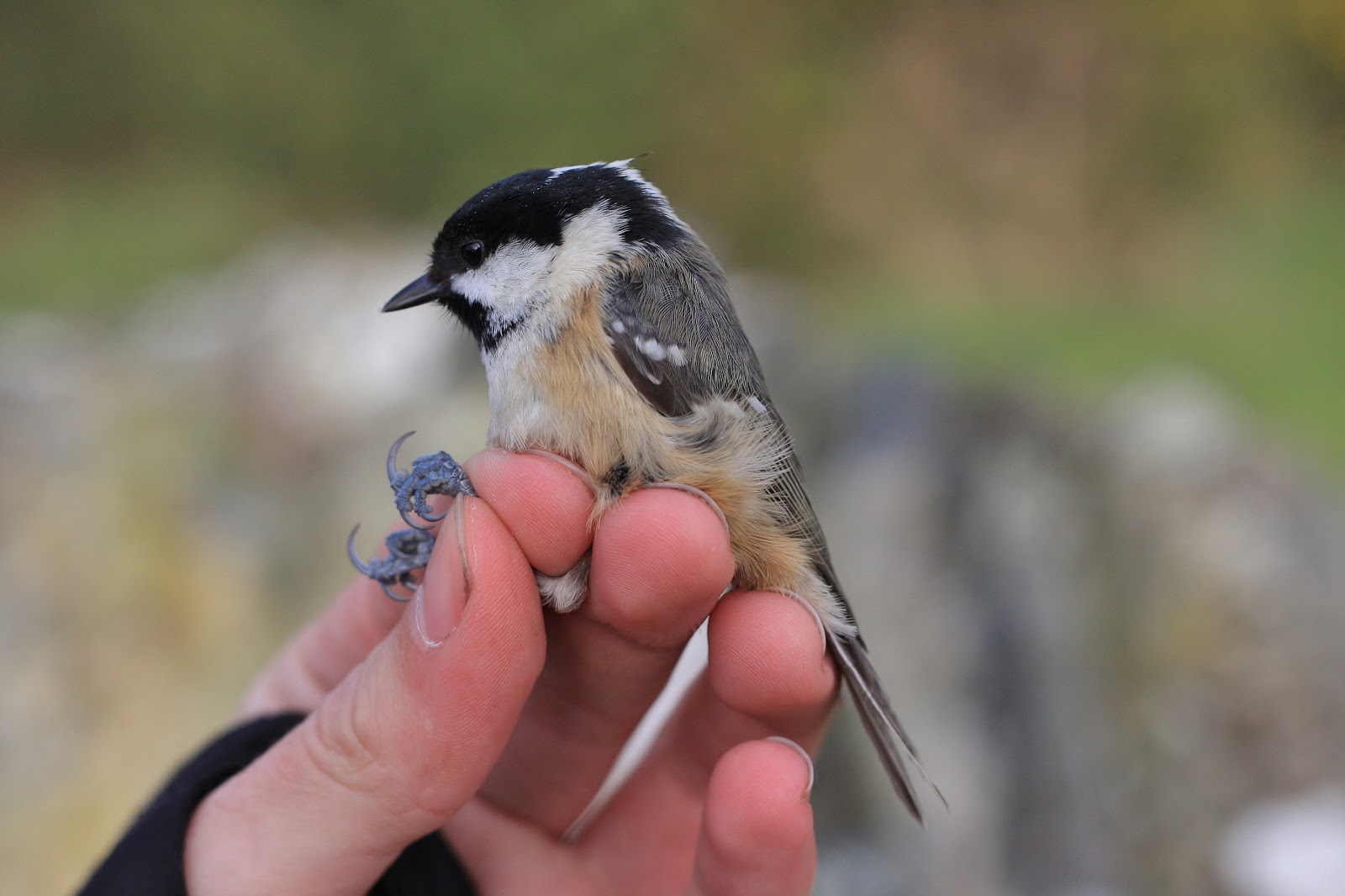
 22nd Coal Tit ringed with my C-permit.
I spent an afternoon on Bangor Mountain today taking advantage of the Spring sun and the rare lack of strong wind in North Wales! It feels like forever since I got out ringing by myself.

It wasn't an outstanding catch, but 2 Long-tailed Tit, 2 Coal Tit, 2 Dunnock and a Great Tit made for a nice relaxing afternoon in the sun.

Friday, 15 February 2013

Llinos y Mynydd Twite! - 15th February 2013

 Colour-ringed Twite
Flint Castle
With Twite now on the move back to breeding habitat, birds are moving along the Welsh Coast from the Dee, so we went to Flint today where there was a superb flock of c40 Twite gathered on the high tide. It was great to see the birds so well as it's a bird I rarely see and certainly rarely see well. We managed to see 4 colour-ringed birds including: Orange above Metal, White above Yellow, which was a bird that isn't from the known Welsh population which was great.
The highlight was of course catching and ringing a lovely 1st winter bird that was duly colour-ringed. A new species for me in the hand, and a taste of the near-future as I will be taking over the N.Wales project for a Post-grad degree.

A really enjoyable day thanks to Kelvin and Matt.

Wednesday, 30 January 2013

Oystercatcher Colour-ringing Project - North Wales

In coordination with Bangor University and the British Trust for Ornithology (BTO), a colour-ringing project has been set up on Oystercatchers in the Lavan Sands area. The aim of the project is to observe longevity, site-faithfulness, juvenile feeding dispersal e.g. fields rather than sands etc as well as a mark and recapture technique of counting the how many birds are in an estimated flock size. Several counts like these will be sufficient to estimate the population size of the important wintering population of this impressive pied-wader.
The rings are as shown above: Green ring with a white engraving and an orange ring above.


If you are to come across any birds, whether it be a full ring code, partial ring code, or just a count of ringed birds in an estimated flock, please email: oystercatchers 'at' fidhw.com

Monday, 28 January 2013

German colour-ringed Curlew near Bangor!

 I hope Mike Watson won't mind me borrowing his image, and 'adding' colour-rings on Paint!
The bird is a German breeder and happens to winter on the Lavan Sands of N.Wales!

On 13th January, Matt and I walked to Llanfairfechan and back via the Spinnies/Aber Ogwen for my first trip out for the Foot It list. Whilst waiting for the birds to arrive at Spinnies at high tide, I scanned the Curlew flock that were roosting right in front of the hide, which was excellent for checking for rings! There were lots of metal ringed birds (on the tarsus) which were probably birds ringed in the area by SCAN, but I then noticed a red metal ring on a birds left tibia, as well as a metal ring on the right tibia. This was no doubt a foreign bird and really exciting. Sadly, it would appear to have dropped a couple of rings as there are no schemes with a single red ring.
A bit more searching and I spotted yellow and black! This bird showed a full combination or Right Leg: Green above Metal (tibia) and Left Leg: Black above Yellow (tibia).
This was a sufficient combination to send off and get the details of...

History:
Ringed on 28.02.2009 by Sean R.G. at Abergwyngregyn, near Bangor (FH 14979)
Colour-ringed on 16.05.2010 at Syen-Venn, county Nordhorn, Germany on territory. (returned to territory until 2012)
Resighted on 13.01.2013 by me at Aber Ogwen NR, Gwynedd

I was astounded to find out that the bird was originally ringed only a couple of miles away!

A really interesting bird!

Saturday, 26 January 2013

Walking to the edge - 26th January 2012

At the start of Footit, I think you it's natural to wonder how far you are prepared to walk from your house, and the initial estimate isn't very big at all. On the first day, Matt and I decided to push the boundaries that little further and walked all the way to Llanfairfechan and back, which as the crow flies, is 7 miles from my house, but is actually more like 8.5 after cutting out Porth Penrhyn.
As a result, we decided to draw a circle around Bangor with the same 7 mile radius as this could easily be done. Ideas started to flow when we saw what sort of habitats we could cover and today, I woke up at 4am and set out alone to Malltraeth Marsh, right at the edge of my circle. The walk saw me arrive at Malltraeth at 6.45 after a 9.2 mile walk in complete darkness.
As the sky started to get lighter, I started hearing the first birds and these were mainly Snipe and Redwing. I noticed a large heron flying over the reeds in silhouette, but I just couldn't be sure it was a Bittern, so this really frustrated me. It wasn't long before I got my first Footit Tick in the form of a Water Rail shortly followed by a flock of 6 Pink-footed Geese flying over the marsh. Shortly after this, I started walking to a body of water that held over 300 Coot as well as several Gadwall and Pochard which were both big surprises! I then caught the familiar song a Cetti's Warbler which again was real quality and a bird we could only get here.
As the sun came up, I knew that that Heron sp was probably my missed opportunity for Bittern, which was disappointing, but this soon went away as a male Marsh Harrier flew low over my head!
The next two birds that I ticked off were two birds that I was incredibly surprised I hadn't got by now and birds I should have gotten on my very first day! These were Reed Bunting and Pheasant! I jumped in the air when the Pheasant first called!
I was extremely tired at the point and I think I knew that I wasn't likely to get that much if I stayed any longer, so I decided to walk the 9.2 miles home to complete the 18.4 mile journey! After covering the majority of the journey home, I noticed some geese in a field which all turned out to be Canada Geese! Another bird that I probably should have got by now, but these are really hard to come by in the Bangor area and I only remember seeing them 2 times before today!

A really really tiring day that the blisters on my feet are reminding me about, but with 19 new species in 48 hours, you really can't complain!

Friday, 25 January 2013

Joining the Footit100 club! - 25th January 2013

Wonderfully dark-headed Common Gull that momentarily gave me a fright!
Setting off before first light this morning, Matt and I decided to walk to Llanfairfechan and back as part of our Footit challenge. Matt went a couple of days ago and picked up lots of birds that I need and we couldn't allow that!
We arrived at the Spinnies/Aber Ogwen NR just outside Bangor for dawn and almost the first bird I picked up on the sea was a Smew! This is a redhead that was present over the Christmas period that Matt managed to get when he came back to Bangor after the New Year but hadn't been seen since so I was really worried I wouldn't get it on the list. I was very very happy to get this!
Golden Plover was a bird I really didn't think I would get on my Footit list as they are certainly not common on the NW.Wales Coast
The walk between The Spinnies and Abergwyngregyn, I picked up three footit ticks in the form of 10 Golden Plover, 2 Grey Plover and a candidate for the best bird of the day which I noticed calling behind us as we were scanning the Curlew flocks. It was obviously a crest, but it just didn't sound right for Goldcrest as it got 'more excited' as the call progressed. It was in fact a Firecrest! Fantastic! A great bonus for patch and Footit. Matt almost managed to 'grip back' Skylark off me as we were watching and listening for the crest.
1 of 4 Stonechat seen at Morfa Madryn NR. Another bird I didn't think I'd get, so a real bonus!
Walking from Morfa to Llanfairfechan, I picked up Stonechat for my Footit which I also believe to be a patch tick as I can't remember ever seeing one along this coast.
Seawatching off Llanfairfechan, we picked up lots of Red-throated Divers, Razorbill, Fulmar which were all ticks as well as 4 Slavonian Grebe.
After seawatching at Llanfairfechan, we walked back via the sewage works near Morfa Madryn. It's a place I've never birded before, but what a little gem! There were just 100's of birds around such as Redwing, Meadow Pipit, Song Thrush, Blackbird, Chaffinch, Pied Wagtail, Grey Wagtail, Robin, Dunnock, Wren and Goldcrest all feeding on presumably invertebrates on the sewage plant. In the surrounding bushes, there was a hive of activity with lots of crest flocks. All of a sudden, I caught sight of a very angry little face and was amazed that I was looking at my 2nd Firecrest of the day! We saw the bird on and off throughout the 30 minute stay, but we were pretty sure there was a second, but with the speed that crests can move, we couldn't be sure. Possibly the highlight of the day came in the form of a warbler and this was a Chiffchaff! I spotted a fantastically green bird in the bushes that I was confident to be a 'collybita', but 5 minutes later, I spotted basically a white blob in the bushes at the back of the plant. Frantically getting my scope on it, I was very shocked that it was a Chiffchaff and a bloody cold one at that! It has an obvious supercillium, very cold breast and belly with slightly darker wings and when it flapped it's wings, I noted a lemony wash to the underside of the carpal and front auxiliaries. I was pretty confident this was a Siberian (tristis) Chiffchaff, so I fired off a few shots to at least get a record. The photos are horrible, but they at least show the coldness of the bird.

A fantastic day for the two of us and we are both now on 103 for our patch/footit list.
My 'Footit ticks': Smew, Grey Plover, Golden Plover, Firecrest, Stonechat, Razorbill, Red-throated Diver, Fulmar, Chiffchaff
Matt's 'Footit ticks': Firecrest, Skylark, Razorbill, Fulmar, Chiffchaff.

Tuesday, 22 January 2013

Another of Chris's Siskins! - 20th January 2013

During revision, I have been writing up practise questions at Matt's house and checking the 30ft mist-net I erect in his garden. It's a nice relaxed for of ringing as the birds are quite sporadic.

The above and below male is actually a control. Not an incredible control of many kilometers, but a bird that was ringed in Matt's garden last year (different to the one he lives in now). This was ringed by Chris Bridge and is the 2nd control of his that I've caught so far. Really nice to see the same birds returning!

It was reasonably windy throughout the morning, so I fear the birds may have seen the net, as we only caught 10 birds, but it was nice and relaxed and what better way to spend your Sunday morning, revising!?

We caught 4 female Blackbird (+1 recapture male), 4 Siskin (inc. 'control') and a single male Chaffinch.

Once the colour-rings arrive, I will do a full blog post about the Bangor Blackbird Project which we are in the process of setting up.

Tuesday, 15 January 2013

Bangor garden - 15th January 2013

adult male Siskin
Today I did my first 'C' ringing session in Bangor in Matt's garden. We were set by dawn and despite the garden being rather quiet, I was really happy with the catch of 5 Siskin, 4 Blackbird and a Dunnock.
The Siskin was new to the permit, but the most exciting bird was an adult female which was already ringed! It turns out that it was one from Matt's old garden about 700m away from his new garden where Chris Bridge went ringing last year.
2cy male Blackbird
Speaking to Kelvin Jones in the BTO office, we are going to set up a long-term Retrapping Adults for Survival (RAS) project on breeding Blackbirds within the University grounds. My two ringing sites (including a spot on top of Bangor Mountain) are just outside the study area, so we won't be colour-ringing any. Instead, we are catching this generally in the Winter months, so the vast majority are probably migrants, so we are going to be taking full biometrics on these birds to see if there is any obvious biometric difference between the Winter and Summer population of Blackbirds
More on the actual ringing project when we start it properly...

Friday, 11 January 2013

New Years Resolution - Give Blood! - Jan 2013

 My first ever Jay! It left quite an impression!
I have only just been able to get out in 2013 to do some ringing, so I started at my feeding station in the woods. It's been really slow, but I have been able to catch an adult Jay! This is my first ever and a species I have wanted to catch since the start for the simple fact that they are both beautiful and what initially got me into birds in the beginning!
I have also caught quite a good number of tits and Blackbirds as well as 2 new species for my permit in the form of 5 Chaffinch and an adult male Greenfinch
Back to Bangor tomorrow, so will hopefully get some decent ringing done in and around Bangor. Happy New Year to you all!

Monday, 24 December 2012

Waiting for the frankincense and myrrh... - 24th December 2012

Arriving at my feeding station at dawn, I was expecting lots of birds to start of Christmas Eve but the place was devoid of birds! I gave it two hours of nothingness before giving up and heading back to my garden.
Even here the birds appeared to be lacking but eventually I spotted the above juvenile female Goldcrest in the 2nd shelf. A lovely bird to catch in my garden and a nice bird to get on Christmas Eve!

Merry Christmas to all my blog readers!

Friday, 21 December 2012

New feeding station - 21st December 2012

1 of 5 Long-tailed Tit

I have very recently set up a feeding station in my local woods. This morning I decided I'd have a go at netting it for the first time.
It was surprisingly productive considering how new the station was and I caught 25 birds with the highlight being a group of 5 Long-tailed Tits

Totals
10 Great Tit
5 Long-tailed Tit
5 Blue Tit
4 Coal Tit
1 Robin

Tuesday, 18 December 2012

First ringing session as a C-permit holder! - 18th December 2012

My C-permit arrived through the door yesterday and I was eager to get out ASAP to have a go for myself. I erected a 30ft net in my garden for just after 1st light and caught a Dunnock before the net was even fully up!
The last bird of the session was a real surprise being a Treecreeper! This is actually a garden tick for me, let alone a great bird to ring on the first day of my permit! I am still in a slight bit of shock!

Totals weren't amazing, but a nice easy session to ease me in:
3 Blue Tit
3 Coal Tit
2 Dunnock
2 Blackbird (inc. 1 retrap from 2011)
1 Treecreeper

Monday, 17 December 2012

Gulls are like buses! - Preston Docks - 17th December 2012

1 of 20 Black-headed Gulls hand caught at Preston Docks
Kane, Gillian and I went down to Preston Docks today to have a go at hand catching a few gulls. When we arrived, the chip van that is usually always there, wasn't. As a result, the gulls were very hungry indeed and were incredibly easy to catch! It didn't take long at all before we suddenly had 6 in the car ready to be ringed. After the first 15, they became a little more nervous to approach us, so the final five took a bit of time, but to hand-catch 20 in just over 30 mins was superb!

We fitted a darvic ring on every bird and we have now reached 2F19. Hopefully we can get a few repeat days like this due to either cold weather, or a lack of food. They really did appreciate the food we gave them today.

I haven't ringed a UK Black-headed Gull since Ireland, back in January, so it was fantastic to get my hands on lots today. One of my favourite birds to catch without a doubt.

My permit has now arrived through the door, so I hope to get out as much as possible in the next week or so, whether that be ringing in the garden, or out grabbing.

Tuesday, 4 December 2012

2 years of training have been worth it!

I began training to ring birds on January 29th 2011 with Steve Dodd as my trainer. Since then, I have ringed birds in Lancashire, Cheshire, Gloucestershire, Gwynedd, Conwy, Anglesey, Gtr Manchester, Cumbria and Powys as well as a 7 week trip to the Kvismaren Bird Obersatory in Southern Central Sweden.
In this time, I have handled 105 species including some of my favourite birds in the world (Willow Tit, Bluethroat and Dunlin) and processed an impressive 4500+ birds.
Today I received an email to say that my application for Full C ringing permit has been accepted! I have now sent off the money and should have my permit in the post before too long!

I have put a hell of a lot of effort into my ringing training over the past 2 years and it all seems worth it now I am able to do it by myself.

I would like to say a big thankyou to the people I ringed with and to the people whom have made it a thoroughly enjoyable experience: Steve Dodd, Kane Brides, Christopher Bridge, Craig Brookes, Ciaran Hatsell, Matthew Bruce, Gillian Dinsmore, Ian Lees, Kelvin Jones, Richard De Feu, Adrienne Stratford, Tony Cross, Rachel Taylor, Mark Breaks, Steve Christmas and the rest of the SCAN Wader ringing group.

Hopefully now I have a permit on the way, I will be able to blog a little more!

Saturday, 27 October 2012

Mist-netting Passerines - Caernarfon, Gwynedd - 27th October 2012

Today I went out ringing passerines for the first time since Sweden (except for a Swallow in September) so it was strange getting to terms with British ringing terms again and slightly different ageing and sexing criteria.
Redwings were certainly the main species of the day with 17 caught throughout the morning, along with a Chiffchaff, 3 Goldcrest and 3 Wren.
Totals for the mornings being:
Redwing - 17
Blackbird - 1
Song Thrush - 2
Coal Tit - 1
Blue Tit - 7
Great Tit - 10
Long-tailed Tit - (1 retrap)
Dunnock - 1
Robin - 1
Wren - 3
Goldcrest - 3
Chiffchaff - 1
House Sparrow - 5
Chaffinch - 11

A really lovely crisp morning with lots of Turdidae on the move. It was good to be out.

Saturday, 20 October 2012

Pallas's Warbler - Knott End, Lancashire - 20th October 2012

Pallas's Warbler - Knott End
Visiting home for the weekend for my grandparents' diamond wedding anniversary, it happened to coincide with the presence of one of the prettiest birds on the British list being 'within reach'. I got up early and set off to Chris Batty's house in Knott End where he found a fantastic Pallas's Warbler feeding in a Sycamore in an adjacent garden earlier in the week! Arriving on site, I walked round the back of the house and joined Chris and 3 others who were looking at the bird. It proved rather elusive for a lot of the time, but occasionally, it would show itself fantastically at the front of its favourite Sycamore. I generally like to get a good photo from a twitch for the blog, but today, I thought that no matter how good my equipment was, I would never be able to show how beautiful this bird actually was in a photo, so I decided to fire off a couple of record shots to get the diagnostic features, and then soak in the beauty of the bird! What a little stunner and thank you very much to Chris Batty for allowing all us 'dirty twitchers' into your home.

Wednesday, 17 October 2012

Red-breasted Flycatcher - Breakwater CP, Holyhead - 17th October 2012

 1st winter Red-breasted Flycatcher.
Chris Jones picked me up on his way to Breakwater CP to twitch the 1st winter Red-breasted Flycatcher that Ken found at lunchtime.
The bird had been seen 5 minutes before we arrived so were pretty hopeful, however the bird proved really difficult and it seemed like an age before I heard a rattle and a pipe coming from in the undergrowth. A bird landed on a branch in front of us at about 40 feet and I was rewarded with pleasing views of my first 'tickable' Red-breasted Fly. (I had frustratingly untickable views of a bird in Filey back in 2010)
The bird showed a lovely warm wash to the throat and obvious black and white tail as it cocked it's tail, as well as in flight. The bird was surprisingly vocal as well as being very mobile, so excuse the poor photos!
A really nice bird and a great bird to see locally!

Tuesday, 16 October 2012

Short-billed Dowitcher and Pallid Harrier - 7th-8th October 2012

Better late than never! I have had some real issues with my laptop over the last couple of weeks, so have not been able to blog about my awesome weekend with Chris Jones as we ventured to Dorset and South Yorkshire result in 2 lifers each. We started off by twitching (can it be called twitching if the bird has been present for so long!?) the Short-billed Dowitcher at Lodmoor RSPB. We were rewarded with really nice views down to 60 feet as it fed with Snipe, Lapwing and Black-headed Gulls.
Juvenile/1st winter Short-billed Dowitcher - Lodmoor RSPB, Dorset
The infamous tertials of Short-billed Dowitcher was instantly evident when the bird was turned to it's side
When the bird arrived it was in fresh juvenile plumage but has subsequently started it's moult into 1st winter plumage with some moulting of the scapulars and upper mantle feathering. The body feathers appeared to be very much 1st winter also.
Open-wing shot.

An extract from my notebook describing the plumage of the bird and distinguishing features I picked up on: 'Juv/1stwinter bird. Partially completed wing moult with most of scaps and some of upper mantle moulted. Classis SBD teritals with black centres and golden brown barring similar to rest of juvenile wing coverts. Obvious supercillium on grey head with obviously darker car. Bill seemed broad based with yellowish fade towards base. Barring subtle but obvious on breast and flanks. Yellowy-green legs that must be short on tarsus as bird seemed very squat, even when alert. Feeding with Snipe, Lapwing and BHGulls and appeared larger and stockier than Snipe and was only slightly smaller than Lapwing.'
2 Med Gulls flew low overhead whilst we were watching the Dowitcher.
After watching the Dowitcher, we made our way to Portland Bill with the hope of some migrants and some seawatching. We dipped a Red-backed Shrike and failed to see any Balearic Shearwaters on our seawatch, but were amazed by a feeding flock of 40+ Mediterranean Gulls and 10-15 1st winter Yellow-legged Gulls offshore.
Heading back towards the north, we stopped off at Greylake and were rewarded with brief, but pleasing views of a Spotted Crake.
We were intending on getting to the Pallid Harrier in South Yorks. for dusk in time to see it roost, but were held up in traffic and it was going to be marginal, so we took our time and stayed the night in Doncaster ready for dawn.
Arriving on-site before dawn, we joined an assembled group of 20 birders, inc. Alex Jones. It seemed to take an age for the sun to rise, but as 07.15, someone called the bird and I lifted my bins and picked up a white flash (rump) above the trees. I quickly picked the bird up in the scope and revealed a long winged, thin bodied and thin winged harrier with a thin 'hand'. The bird was an adult female and Pallid was proven by the really obvious dark secondaries and what looked like a pale 'flash' along the median coverts. The underwing wasn't seen for very long, so I can't give an in depth description, but they certainly appeared dark on the secondaries as the base of he wings, near the auxillaries seemed dark, lacking any barring.
The bird was seen for 15-20 seconds as it flew off to feed out on the fields, and what turned to be a departure from the site for ever! We were very lucky

Similarly, the Dowitcher disappeared the following day too, so we were able to see both birds on their last days! Two really great birds and lifers and a really enjoyable weekend. Thanks to Chris for the invite, doing the driving and stumping up for the hotel!

Saturday, 22 September 2012

Americans on the Wirral! - 20/21st September 2012

When news broke on Wednesday about a Semipalmated Sandpiper on the Wirral, I was quite excited as this is a species I should really have caught up with by now, however they are very very rare in the north west, and I believe Lancashire has only had 1 prior record (Brockholes LWT). When photos were uploaded to Surfbirds, things weren't as simple as you might first think as the bird seemed to look very much like a Western Sandpiper due to a long curved bill and rufous fringed scapulars. The bird was put out as possible Western Sandpiper.
After the Western Sandpiper at Cley in Winter 11/12 I put quite a lot of research into the splitting of these two similar species so I used all my past references to make my mind up about this bird. I kept going back and forth between ID's as in some photos it looked very Western and in others looked very Semipalmated. I know from past experience that photos can be very misleading and show a bird in a completely different light to what it actually looked like in the flesh which can make you believe a bird is something else. As a result, I decided that I would go for this bird on Thursday to try and make my own mind up on what this bird is.
I arrived to a crowd of about 40 people watching a flock of Sanderling, Dunlin and Ringed Plover. They had seen the bird, but the group had lifted just before I arrived and then settled, so the bird had been lost.
I then joined Chris Batty, Stu Piner, Chris Galvin and Steve Young on the next road along called Curzon Road, and after about 15 minutes of scanning through the flock, Chris Batty picked the bird up at the front of the group. I managed to get onto it almost straight away and was amazed at how much it looked like a miniature Sanderling. The bird was quite distant at c75 meters and in reasonably poor light so I wasn't able to view the finer details of the plumage like the scapulars etc, so I focussed more on jizz of the bird and structure.
The bird has next to no legs for the majority of the time and certainly didn't look leggy like I would generally expect Western to do so. The bill was quite long with a slight curve at the tip. Subsequent reading has taught me that East Coast female Semipalmated Sands can have a long bill with a curve and even a thin tip, instead of a blob tip, so unless a bird shows a very short bill or a very long bill, this feature isn't a sensible feature to use to help with ID. The bird fed by pointing its bill downwards at '7 o'clock' with a bull neck and a concise structure as though the bird was a little ball. It never pointed its bill forwards or stuck its neck out. In terms of position of its legs, they did appear quite far back on the bird with quite a lot of the bird in front of the legs. This is quite often a good indicator of species as Western's legs are really far back. I don't feel that in this particular case, legs position is useful as the bird was facing into strong wind so this could have just been the bird trying to stay stood up! At the distance I was viewing, I couldn't get a feel for the shape of the birds head, but I did note it seemed reasonably large. The face was again a little too 'small in my scope' to get any great detail, but I certainly saw dark ear coverts and what appeared to be a faint supercillium presumably meaning the crown was quite dark.
After 5 minutes of intense viewing, the whole flock lifted and the bird was never located again. I went home with the impression that if I had found the bird, I would sent it out as a probable Semipalmated Sandpiper as I just couldn't turn it into a Western despite trying based on the picutres I saw.
Further reading on Thursday night and observing Steve Youngs photos made the bird look like a Western Sandpiper and the American birders that were asked for their opinions seemed to all think it was a Western. I just couldn't get this impression in the field, so I really wasn't happy and if it turned out to be a Western, I wouldn't be happy with ticking it. I also personally thought that on a lot of photos, it looked like a Semi-p and of the videos of Western and Semip's I watched on Youtube, the Hoylake bird matched Semi-P. I wasn't happy, so talking to Alex Jones, I arranged to go the following day with him to hopefully get better views with better knowledge to hand.
Western/Semipalmated Sandpiper - photo Alex Jones
I met with Alex at Rhyl station for 10.40 and we headed off to Hoylake with a quick detour to Burton Mere Wetland to catch up with a Juvenile Sabine's Gull that appeared the day before. We got really good views of it and it was nice to compare it in structure to the Black-headed Gulls and also see a Sabine's Gull as well as in flight. I have only ever seen one sat before and that was back in 2001 at Seal Sands (I hardly remember the finer details I was 9!)
We made our way to Meols at the base of Roman Road and were pleased when a flock of Dunlin landed about 50 meters away and within 10 minutes, the bird was picked up in brilliant light and we were able to watch the bird for half and hour before it started flying around. It then landed slightly closer and then walked even closer on the rising tide. The views were really pleasing and I was able to pick out the colour of the scapulars which I would suggest was a rich ginger colour that I would certainly say fell within the colour variation of Semipalmated Sandpipers. I was keen to observe the nape as I had read that Western show a very little contrast in colour between the nape and the cap whereas SemiP do. The bird showed a clear dark cap and a pale nape so there was an obvious contrast. The supercillium also seemed pretty obvious compared to the cap and the similarly dark ear coverts. When the bird walked towards us, I (along with Alex Jones) was sure that the breast showed a very faint buff tinge instead of clean white which would be a feature of SemiP. The flock then took flight.
White Rumped Sandpiper - Photo Phil Woolen
Moving down to Hoylake, We found the flock again and within about half an hour, there was a rumour going around that someone had found a White-rumped Sandpiper. Another species that I should have seen by now, but hadn't! It turns out that this wasn't a rumour and someone had found out. The wind was picking up and the flock took flight! I was gutted! However, they landed again and about about 10 minutes scanning, I managed to refind the bird in the flock! I was so happy! This was a fantastic adult White-rumped which was 75% of it's way through the moult into Winter Plumage so appeared quite grey in appearance. The bird was surprisingly smaller than the Dunlin it was with with a really thin body. The primary projection was obvious and it was nice to see the crossed primaries. The main feature that allowed us to pick the bird up was the really obvious supercillium behind the eye. A fantastic bird!

After lots of reading, and lots of views of the bird, I am almost 90% sure the stint sp is a Semipalmated Sandpiper and the only reasons why I am not 100% is that fact that I have no field experience with either and the American birders think it's a Western...

Thanks to Alex Jones for the lift and to Alex and Phil Woolen for use of photos.
Tuesday, 11 September 2012

The one that got away - Brockholes NR LWT, Lancashire - 11th September 2012

Adult winter Kittiwake on Meadow Lake (Bill Aspin)

It's strange to not get up every day to ring birds and live birds, so its been nice in the last couple of days to do some patch work.
This morning I arrived at Brockholes with the hope of some migrants after the heavy rain of the night before. Checking Meadow Lake for the ever present Garganey produced the above Kittiwake. It was a fantastic winter adult and has to be one of the most pleasing 'common' birds to find in land. It's always a rush, especially when this is only the 2nd record for 2012 down at Brockholes. Bill Aspin and Peter Bainbridge managed to see the bird before it headed NW at c09.30.
Whilst we were watching the Kittiwake, 3 Black-tailed Godwits flew over the site and headed off SE which was a nice record.
Throughout the rest of the morning there was an obvious movement of passerines with Whinchat and Tree Pipit (seen by Bill Aspin) being the highlights along with Meadow Pipit, Linnet and Goldfinch producing an almost constant chorus overhead. (Interestingly, the visit yesterday was mainly dominated by Siskins overhead and I think I only heard 1 today)

The reason this post is called 'The one that got away' is because, whilst stood in the M6 hide overlooking No1, I was scanning the island when a Starling flock took up from the far side of the large island. In this flock was a small wader that I actually initially thought was a Sand Martin because it seemed hirundine size and was a warm olivey brown on its back and pale underneath. It was certainly smaller than a Dunlin which obviously got the alarm bells ringing as it was obviously a stint sp of some sort. It flew around for about 2 minutes until it flew overhead and I managed to hear it call (producing a light buzzing chatter which lead me to believe it may be Temminck's as it sounded very similar to the flock of 9 I heard in Kvismaren. The colour would match too) It seemed to have a very small head and reasonably short bill. As it flew overhead it was in silhouette which made it difficult to make any plumage detail out, but when it was circling the pool at 150 meters range, I could make out an obvious white wing bar, and what seemed to be a lot of white at the rear end. I couldn't say whether the rump was fully white or not as it was distant and the bright sun highlighted the white. The bird flew across the motorway and onto the working over there which are unviewable. I was praying that it would flush and reappear on No1, but sadly, this was not to be and was never seen again........the one that got away.

Monday, 3 September 2012

Kvismare fågelstation, Sweden - Day 53

Today I fly home, so I thought I would sum up the trip by listing the totals for the observatory over the past 53 days. Over 3000 birds have been ringed and processed during my stay and some incredible species have added to that total.

Teal - 2
Sparrowhawk - 1
Little Ringed Plover - 1
Ringed Plover - 4
Lapwing - 3
Knot - 1
Curlew Sandpiper - 1
Ruff - 4
Snipe - 4
Wood Sandpiper - 19
Common Sandpiper - 6
Black-headed Gull - 1
Common Tern - 3
Great Spotted Woodpecker - 2
Lesser Spotted Woodpecker - 4
Sand Martin - 20
Swallow - 850*
House Martin - 1
Tree Pipit - 54*
Yellow Wagtail - 4
Grey Wagtail - 1*
White Wagtail - 61
Wren - 4
Dunnock - 3
Robin - 123
Thrush Nightingale - 14
Bluethroat - 1
Common Redstart - 3
Whinchat - 1
Blackbird - 22
Fieldfare - 4
Song Thrush - 7
Savi's Warbler - 1
Sedge Warbler - 199
Marsh Warbler - 18
Reed Warbler - 609
Great Reed Warbler - 36
Icterine Warbler - 3
Barred Warbler - 1
Lesser Whitethroat - 10
Common Whitethroat - 28
Garden Warbler - 68
Blackcap - 53
Wood Warbler - 2
Willow Warbler - 469
Goldcrest - 6
Spotted Flycatcher - 16
Pied Flycatcher - 22
Bearded Tit - 47
Marsh Tit - 12
Willow Tit - 1
Coal Tit - 1
Blue Tit - 144
Great Tit - 107
Nuthatch - 8
Treecreeper - 3
Penduline Tit - 10
Red-backed Shrike -4
Starling - 5
Tree Sparrow - 9
Chaffinch - 65
Greenfinch - 21
Goldfinch - 2
Common Rosefinch - 1
Yellowhammer - 13
Ortolan Bunting - 1
Reed Bunting - 169

*The Swallow and Tree Pipit totals are in fact the highest ever annual totals for the observatory, which is really great to be part of, as well as Grey Wagtail being the first ever to be ringed since the observatory opened in 1961! They aren't common here at all!

In terms of lifers for the trip, Thrush Nightingale, Savi's Warbler, Marsh Warbler and Penduline Tit were lifers that I ringed as well as seeing Red-throated Pipit for the first time yesterday. I also managed to see a few new races of birds including Coal Tit and Nuthatch.

These past 7 and a half weeks have been just incredible! I've have never had such an intensive period of 24/7 birding! Although on paper, the past 7 weeks appear as what you see above, but to me, it will be remembered forever as a pure learning experience picking up techniques and practise that you can only 'learn by doing'. I can't thank Craig Brookes enough for his help over the past 53 days as he's taught me some ringing techniques that should hopefully push me that tiny bit closer to reaching the goal of a 'C' permit in England. Also, thanks must go to Heather McGinty for making for a thoroughly entertaining and enjoyable break from the reality of the UK. Finally, thank you to all the past members of the team that visited Kvismaren during my stay.

A trip I will remember forever!

Sunday, 2 September 2012

Kvismare fågelstation, Sweden - Day 52

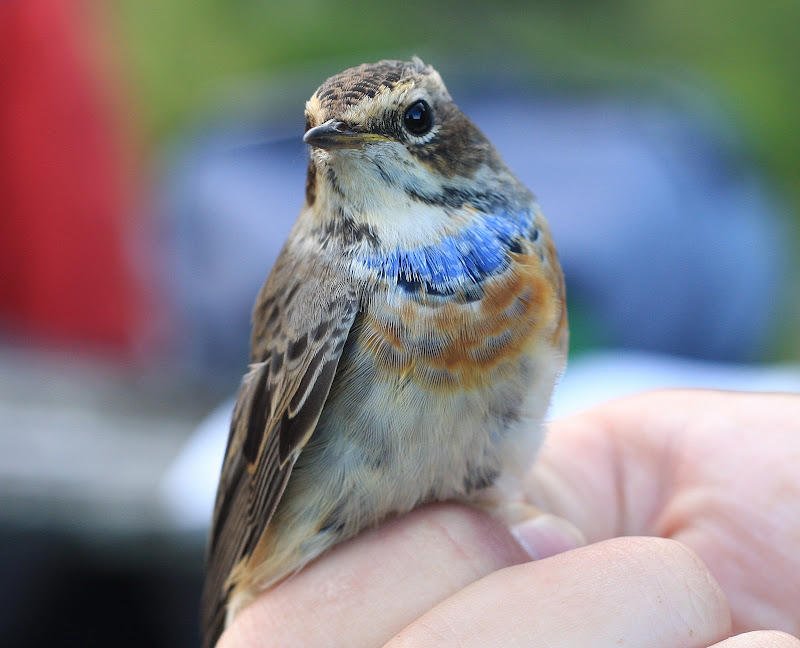
Below are the top three species I have ringed whilst in Kvismaren in terms of enjoyment ringing, and surprise of how much I actually enjoyed ringing them due to learning about their ID etc. The Bluethroat of course didn't surprise in terms of how much enjoyment it gave me, because they are one of my favourite birds and I knew that if I were to ring one, I would be over the moon...I was just over the moon and it went straight to No.1!
Number 1 - Bluethroat / Blåhake
Number 2 - Barred Warbler - Höksångare
Number 3 - Marsh Warbler / Kärrsångare
Number 4 - Thrush Nightingale / Näktergal

This morning we went to Banvallen, but had to take the nets down after a short period of time due to rain. We were only able to catch 7 birds comprising of 3 Robin (1 retrap), 2 Blackbird (1 retrap), a Song Thrush and a Dunnock.

As a result I thought, as today is my last full day, I should post my personal totals for the trip, followed by the stations totals tomorrow.

I have ringed 1217 birds of 56 species with 28 new species experienced in the hand (in bold below)

Species I've ringed since I started work on July 14th:
Ringed Plover - 1
Ruff - 2
Snipe - 2
Wood Sandpiper - 9

Common Sandpiper - 3
Black-headed Gull - 1
Common Tern - 1

Great Spotted Woodpecker - 1
Lesser Spotted Woodpecker - 1

Sand Martin - 7
Swallow - 281
Tree Pipit - 16
Yellow Wagtail - 3
Grey Wagtail - 1 - 1st to be ringed at Kvismaren ever!
White Wagtail - 27
Wren - 2
Dunnock - 3
Robin - 49
Thrush Nightingale - 6
Bluethroat - 1
Redstart - 1
Whinchat - 1
Blackbird - 8
Fieldfare - 1
Song Thrush - 5

Savi's Warbler - 1
Sedge Warbler - 68
Marsh Warbler - 6
Reed Warbler - - 221
Great Reed Warbler - 7
Icterine Warbler - 1
Barred Warbler - 1
Lesser Whitethroat - 2
Common Whitethroat- 14
Garden Warbler - 19
Blackcap - 26
Willow Warbler - 169
Goldcrest - 3
Spotted Flycatcher - 6

Pied Flycatcher - 9
Bearded Tit - 14
Marsh Tit - 6
Coal Tit - 1
Blue Tit - 57
Great Tit - 45
Nuthatch - 2
Treecreeper - 1
Penduline Tit - 1
Red-backed Shrike - 1
Starling - 5
Tree Sparrow - 9
Chaffinch - 25
Greenfinch - 8
Common Rosefinch - 1
Yellowhammer - 2
Reed Bunting- 53

Saturday, 1 September 2012

Kvismare fågelstation, Sweden - Day 51

1cy male Bluethroat (Blåhake)
wing and tail of the Bluethroat (Blåhake)
Stunning throat of Bluethroat (Blåhake)
1cy male (Continental) Coal Tit Periparus ater ater (Svartmes)
Wing of Coal Tit - Note 'extensive' black to the bases of the Lesser Coverts sexing this as male and outer two juvenile Greater Coverts ageing this as a 1cy.
The almost Navy Blue mantle of the Continental race of Coal Tit makes this race look incredibly different to 'ours'

Hectar and I went to Öby Kulle this morning whilst Craig, Heather, Tage and 3 newly arrived Austrian and German girls went to Vallen
Hectar and I only managed to catch 15 birds including 3 recaptures, but there was some quality in our catch.
We managed to catch 2 Robins to help with Hectar's project, as well as 2 Tree Pipit and a Goldcrest which were nice, but the best bird from Öby Kulle was a fantastic 1cy male Coal Tit. I have never seen the continental race before, so it was really nice to see in the hand and note the obvious differences between the British race and the Continental. The mantle and tail colour seen almost navy in some lights and there appears to be much more extensive black on the head and breast.

I got a phone call from Craig to tell me that they'd caught a Bluethroat at Vallen and I should head down! I essentially sprinted there with Hectar in tow, and was amazed when I arrived that they had left the bird unringed so that I could ring it! I was overwhelmed as I have wanted to see one of these in the hand since I started ringing, and the fact that I was able to ring and process it was just amazing!
Without a doubt one of the top 5 birds I have ever ringed and one of my favourite birds of all time.

I can't thank Craig enough for getting in contact with me and letting me ring it.

Not sure I'm going to beat that between now and Monday when I fly home! If I can beat it, then I will be more than happy to blog about it!