Tuesday, 7 September 2010

Black Terns - Alston Res, Longridge - 7th September 2010


Texts from Gavin Thomas and Gareth Morgan awaited me as I awoke late morning (damn teenagers :P)
10 Black Terns at Alston res were feeding actively at 08.20 at least. I was disappointed as I really wanted Black Tern before the year was out. I know from past lancashire birds, they don't hang around for lazy teenagers to arise from their bed mid-morning. I texted Gavin anyway and he said that they were present after 9.00, meaning they were lingering. I therefore went for them anyway and at 11.00, they appeared on the far side of No.1 and eventually came closer to where I was standing.
The night before held a site first on Alston Wetland in the form of a juvenile Wood Sandpiper in amongst the ducks (found by Gavin Thomas). An overdue site record.

Monday, 23 August 2010

Ring Billed Gull - Alston Res, Lancashire - 18th-23rd August 2010

adult Ring Billed Gull and Lesser Black Backed Gull
3cy Mediterranean Gull

When I arrived back from Holiday on 18th August, I was surprised to hear about an adult Ring Billed Gull at Alston Res found by Gavin Thomas.
Luckily it had been in the previous two gull roosts so was confident that it would stay around for me to finally get a lifer in 2010!
18th - Gavin Thomas soon pointed out the RBG on the water of No1 at about 19.45 - Superb! also present was a Adult winter Med Gull with primary 10 still showing a little black so presumably is in moult from 2nd summer.
19th - Both birds were again present at the earlier time of 18.15
20th - I only saw the Med Gull this evening, but the weather was hideous, so maybe the bird came in last thing.
21st - I was not present this evening, but Gavin Thomas didn't have the RBG for the 2nd night in a row
22nd - Beautiful sun made a change from the weather I had experienced on the 20th! The Ring Billed Gull was with 7 Lesser Blackbacks on the first scan of the water. It was back! The Med gull was joined this evening by a stunning juv bird.
23rd - Bad weather prompted an early start to the roost at 16.30. At 17.00, the 'adult type' med was present, and by 17.25 I had the Ring Billed sitting on the bank next to the tower. I was mildly annoyed because I wanted to get it in flight as I had not seen it yet. At c17.40, the bird took flight and flew to the far end of the res sitting alone. It disappeared soon after this, much to the disappointment of Frank Bird who arrived shortly after and had been present on the first night it wasnt present (20th) too! Due to my early sighting, several other birders arrived to a Ring Billed Gull-less res. The Juv joined the adult med, and as the light was going and everyone's patience was running out, I spotted the Ring Billed distantly to the left of the tower.

A superb bird to have locally. I hope it stays around long enough for someone with decent camera equipment to see it and hopefully read the metal ring on it's right leg (visable on the photo's that I took on the 23rd)

Saturday, 21 August 2010

Catalonia, NE Spain - 7th-18th August

Since 2006 my family and I have been on a summer holiday to the costa bravan region of Catalunya/Spain. The region that I stay, is in close proximity to the Parc Natural dels Aiguamolls de l'Empordà and the Parc Natural Cap de Creus. To try and make this trip a little more different, my father and I went to the Pyrenees for the day to the Val De Nuria.
The first day, I just had a wander around my estate and managed to pick up the regular garden birds of the area: Sardinian Warbler, Nightingale, Serin, Golden Oriole, House Sparrow etc.
Estany de Vilaüt...with WATER!
8th August
I had planned to wake up first thing with my dad so that we could be at the picnic site of Mas Ventos on the road between Vilajuiga and the monastery of San Pere de Rodes. Waking up at 06.30 (GMT+1) I had a scan from the balcony across the costa bravan plain. Estany de Vilaut is usually visable from the villa, so I had a scan towards that and noticed water! This is the first time I have ever seen any water at this site, so I was interested in viewing the pool that Stephen Christopher of Catalan Birdtours claimed to be one oh his favourite sites in the whole of Catalonia.
Arriving onsite, there were 3 Roller in the area of the pylons and arriving in the hide, I could see 150+ White Stork as well as Little Egrets, 2 Spoonbill, Wood/Common/Green Sandpiper, Greenshank, Sniper, LRP, Black Winged Stilts, Garganey and a Great White Egret.
Shortly after this, I made a trip to a local Reservoir and Tip (which would be the perfect gull magnet in England!) Here, the main species by far was Yellow Legged Gull with a minimum of 2500 gulls. Also present were c20 Black Headed Gulls and a juv Med on the water. A Red Kite that I have seen the last 2 years was again present flying around the Tip.
juv Bonelli's Eagle
9th August
My 2nd full day started off with an adult Bonelli's Eagle behind the house. Later on, I decided to try and get some photo's of gulls at Rosas Harbour where I have had at least 20 Med Gulls in the past, and very educational Yellow Legged. This time, I was only able to photograph Yellow Legs, but this was sufficient gulling for me in the pending autumn gull watching of Lancashire!
Rosas Harbour - Juvenile Yellow Legged Gull
moulting 2nd summer/3rd Winter Yellow Legged Gull
Juvenile Yellow Legged Gull
August 10th - A trip to the Salvador Dali house in Port Lligat didn't see too much in the name of birds, however when I got back home, an overcast Pau saw a gathering of Swifts and Hirundines above the house. This included Pallid and Common Swifts and 2 Alpine Swifts stood out like a sore thumb next to the seemingly puny Pallids! Understandably, a flock of Swifts attracted attention from the raptors and I soon picked up two falcons overhead. I first thought they may have been Peregrine, but they had long tails and were very slim looking so I then moved to the idea of Hobby. When I picked them up in the scope, I was amazed to find that they were Eleanora's Falcon! This is the first time I have seen them over the house and was keen to get a photo. My plan however changed when they drifted over the top of the Hill and didnt reappear...

August 11th - No birding today, except Monk Parakeet in the centre of Rosas and Empuriabrava.

August 12th - Today was really the day that I most looked forward to before the trip and I had the potential of seeing at least 10 lifers and seeing scenary that makes Pendle look like a mole hill! My father and I headed off to the Pyrenees near Andorra, to the Val de Nuria. We took the N260 through Figueres, Olot and Ripoll and then headed north to Ribes de Fresar where we got the Rack and Pinion train to Nuria. En route, I was alerted by a roadkill in the middle of the road with a long stripey tail. As we passed, it was clear that it was a Genet! Since reading that they were present in the region, I was keen to see one, however a completely nocturnal cat isn't exactly the easiest mammal to see on a family holiday! Apologies for anyone who is slightly squeamish, but you can clearly see the main features of the Genet...among other parts that you may never normally see!
Also along the way, we took an unplanned detour along a windy mountain road through a forest. Here I picked up a couple of species I have never seen in Spain before: Jay and Robin! Whilst driving along the road, I picked up a brown mammal scurry down a slope and when it reappeared, I was shocked to see a Pine Martin! What a productive drive!

Genet RoadkillCrag Martin
The station at Ribes de Fresar held breeding Crag Martin and a Black Redstart feeding on the train tracks. The train to the top of the valley was certainly the most impressive train journey I have ever been on as we ascended to 2500m. Along the way, I picked up Dipper, Griffon Vulture and Queen of Spain Fritillary. Due to Clouds at the top, it was disappointingly misty, so my visions of Lammergeier and Golden Eagles overhead wasn't exactly proven true. One of the first birds I saw at the top was the most productive bird of the trip in my opinion, as it was the only lifer of the trip! A fabulous flock of Citril Finch! Also present at the top was Black Redstart, Ring Ouzel, Rock Bunting, Dunnock, Chaffinch, and one of the more surprising birds, a pair of calling male and female Common Crossbill!
Deciding to walk down the valley to try and pick up Birds of Prey and Wallcreeper may have been a bad idea. It began to rain within 5 minutes of walking down the valley, and 20 minutes into the trip, we were already soaked to the skin in out holiday clothes (shorts, t-shirt and a hoodie!). It took 2 and a half hours to walk down to Queralbs station. By the time we had reached the station, we had lost the will to live and had potentially ruined all of our equipment. The light rain storm turned into 2 hours of torrential rain and lightning storms. this lead to 'floods' along the hillside paths as we descended. On a lighter note, we saw a cliff face where Wallcreeper breed, but no Wallcreeper, as well as Wheatear, Grey Wagtail and some of the most impressive scenary I have personally ever seen!
It was certainly an eventful and memorable day, but I did come away with 21 species for the trip, so it was also a productive day!
Val de Nuria resort and a dry me!
Torrent de Fontalba and a wet me!

August 13th - A lazy morning 'recovering' from the Pyrenees trip meant that there was enough time in the day to make an evening trip to Cap de Creus. A seawatch produced 14 Cory's Shearwater and 2 Yelkouan Shearwater (the light was behind me so it was obvious that these two birds were not as soft as Balearic, and the underbelly was obviously contrasting to the upper body. Also present was Thekla Lark and Blue Rock Thrush

August 14th - I again woke up for first light and walked up the hill behind the house towards the picnic site of Mas Ventos. I picked up Dartford Warbler, Spectacled Warbler and Red Legged Partridge on the ascent. By the time I got to Mas Ventos, birds were beginning to move around and I picked out: Crested Tit, Wryneck, Pied Flycatcher, Cirl Bunting and Booted Eagle
Crested TIt
Pied Flycatcher
Golden Oriole

August 15th - A relax day saw me watching birds around the house and I was able to watch Melodious Warblers, Willow Warblers and a juv Subalpine Warbler feeding in the pines behind the house. I also picked up Peregrine and later an adult Hobby above the house, making that 4 species of falcon above the house during the trip (including Kestrel)

August 16th - Waking up early, my parents and I went to the Aiguamolls de l'Emporda. Sadly the only water present was a tiny puddle at el Cortalet, however this seemed to hold birds! Scanning through the plovers, I picked up Little Ringed, Ringed, Lapwing, Little Stint and then a passerine with an angry face hopped out of the reeds! A female Bluethroat! I have only ever seen two Bluethroats (including this bird) and both have been at El Cortalet! (see April 2008 trip)
August 17th and 18th - My brother's birthday was on the 17th, so I couldn't exactly go off birding. Surprisingly however, I did end the trip with a Lifer! Whilst having a drink at a Mojito bar, I heard what sounded like a group of 'scared' bats and then an owl flew under a street light. I followed it and say it land in a tree, on closer inspection it turned out to be a Scops Owl!
My mum and I flew back home on the morning of the 18th so that I couldn't be present on Thursday 19th for my A Level Results. I ended the trip on 130 species, and followed this up with a place at Bangor University. For the next 3 years, expect blog updates from the North Wales Coast!

Collins Field Guide Taxonomy - 130 Species
Little Grebe
Cory's Shearwater
Yelkouan Shearwater
Shag
Night Heron
Cattle Egret
Great White Egret
Little Egret
Grey Heron
Purple Heron
Spoonbill
White Stork
Mute Swan
Mallard
Gadwall
Teal
Garganey
Shoveler
Black Kite
Red Kite
Short-Toed Eagle
Griffon Vulture
Marsh Harrier
Common Buzzard
Honey Buzzard
Bonelli's Eagle
Booted Eagle
Peregrine Falcon
Eleonora's Falcon
Hobby
Common Kestrel
Pheasant
Red Legged Partridge
Water Rail
Moorhen
Purple Gallinule
Coot
Black Winged Stilt
Ringed Plover
Little Ringed Plover
Kentish Plover
Lapwing
Little Stint
Snipe
Wood Sandpiper
Green Sandpiper
Common Sandpiper
Black Headed Gull
Mediterranean Gull
Yellow Legged Gull
Feral Pigeon
Woodpigeon
Collared Dove
Turtle Dove
Monk Parakeet
Great Spotted Cuckoo
Little Owl
Scops Owl
Alpine Swift
Pallid Swift
Common Swift
Kingfisher
Hoopoe
Bee-Eater
Roller
Wryneck
Crested Lark
Thekla Lark
Crag Martin
House Martin
Red Rumped Swallow
Swallow
White Wagtail
Grey Wagtail
Yellow (Iberian) wagtail
Dunnock
Nightingale
Robin
Bluethroat
Stonechat
Whinchat
Black Redstart
Wheatear
Rock Thrush
Blue Rock Thrush
Blackbird
Ring Ouzel
Grasshopper Warbler
Reed Warbler
Great Reed Warbler
Cetti's Warbler
Fan Tailed Warbler
Melodious Warbler
Blackcap
Sardinian Warbler
Orphean Warbler
Dartford Warbler
Spectacled Warbler
Subalpine Warbler
Willow Warbler
Spotted Flycatcher
Pied Flycatcher
Crested Tit
Coal Tit
Great Tit
Blue Tit
Dipper
Woodchat Shrike
Jay
Magpie
Carrion Crow
Jackdaw
Raven
Golden Oriole
Starling
House Sparrow
Tree Sparrow
Chaffinch
Citril Finch
Serin
Goldfinch
Greenfinch
Common Crossbill
Corn Bunting
Rock Bunting
Cirl Bunting
Reed Bunting

Wednesday, 18 August 2010

Black Redstart Article - Lancashire Evening Post - August 10th 2010

A nice article in the Lancashire Evening Post about the Black Redstarts I wrote about in the last post. It is nice to see my photos featured in the article, aswell as a quote from Steve Halliwell and myself.

Wednesday, 4 August 2010

Breeding Black Restarts - Stoneygate, Preston, Lancashire - 3-4th August 2010

Juvenile Black Redstart - Preston
1st summer male Black Redstart - Preston

When you hear that a pair of Black Redstarts have been reported in the middle of your City Centre, and in the middle of Summer, you just cannot ignore them! On the evening of the 3rd, I wandered around the area of Stoneygate near to the Bus Station and Warehouse. I started to lose hope as it was getting darker and darker, however, I heard a bird singing, which I initially thought was a Reed Bunting. As I got closer, I heard the wonderful sound of a 'fire' singing Black Redstart.
As I walked across the Ritz Car Park, I saw a dark bird flying around the top of an old building, when a female Black Redstart flew from the car park floor to behind another building with food in it's mouth.
The Light was very poor, and the birds became elusive quite quickly, even though the male continued to sing.
On the 4th August, I returned slightly earlier while the sun was still on the car park. An hour went by with no sign of anything redstart. At 6pm, I heard the male singing again in the direction of Stoneygate. Before too long, I saw a bird feeding on the ground which turned out to be a Juvenile, and therefore confirmed breeding at the site. Moving my car, I was able to get some (personally) fantastic photos of the Juvenile and the 1st summer Male feeding on a nest of ants next to the Christian Science Library.


On Foot - From St John's Church, follow the path/road down the west side of the church with the sign for the 'Christian Science Library' - SD543293
By Road - head down Manchester Road from Homebase stores. When you get to the roundabout take the 2nd right and park in the Ritz Car Park.
View with caution, as I would like these birds to return next year!

Saturday, 24 July 2010

Haweswater, Cumbria - 28th June 2010

Golden Ringed Dragonfly
Juv Wheatear
Sparrowhawk.

(Sorry for another spell of quietness. My Internet has been down...)

I spent a day with my brother in the area of Haweswater in search of the Golden Eagle. The search was however unsuccessful and the only thing golden I saw was 3 Golden Ringed Dragonfly, which made up for the whole trip as I have wanted to see one of these for years!

Wednesday, 23 June 2010

Preston Docks, Lancashire - 23rd June 2010


Has it really been almost 2 months since my last post?!
After dropping my dad off at the train station early on in the morning, I thought I would make a quick trip to Preston Docks to try and photograph the Common Tern colony. I counted at least 15 birds, including 5 chicks which was excellent, because the adults had just started feeding the chicks when I arrived, so were actively flying around hunting.
This colony only really arrived last year with a couple of pairs nesting on the floating jettys, and this has now increased with a little help from the Fylde Bird Club, due to their car tyres that are set out for the Terns to breed on.
My last exam is on Friday, so I hope to get out next week at the latest, with a planned trip to Haweswater. Watch this space...

Sunday, 25 April 2010

'Ashy Headed' Wagtail re-visited!

some slightly better photos of the wagtail from the 23rd April 2010.


Saturday, 24 April 2010

North Wales Coast - 23th April 2010


I spent an absolutely stunning day in North West Wales coast with my mum and dad. After visiting accommodation at Bangor University, we visited South Stack to get some specialist seabirds. Amazingly, this was the first time I had left Lancashire to do some birdwatching all year except for a brief trip to Moore NR, Cheshire.
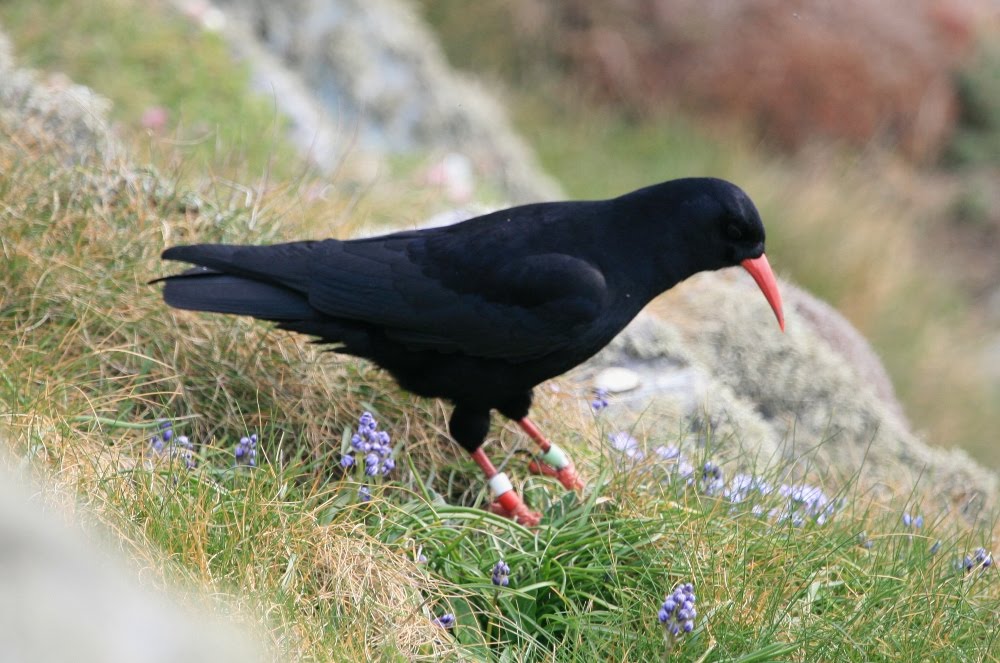
Arriving on site, I saw straight away many hundreds of Guillemot and quickly picked out a pair of Razorbill (yeartick). Also on the first cliff face, I picked up Fulmar (Year tick) and a calling Chough (yeartick) flew over, both of which were wonderful to watch as I love them both, especially the Fulmar (one of my favourite birds)
I was hoping to catch some birds flying past on the sea e.g. Divers etc, so I began scanning the mill pond of an Irish Sea. I spotted a fin briefly poking out of the sea a long long way out, so I stopped scanning. Several pairs of Bottle Nosed Dolphin popped out of the water every so often and it was obvious that there was a large pod of migrating dolphin. I estimated that there were over 50 Bottle Nosed Dolphin in 1 pod...fantastic!
Whilst viewing the dolphins swimming south, I spotted a bird with stiff wings and it was soon obvious that I was watching my first Manx Shearwater of the year.
I managed one more year tick on site, which was one of the more iconic and colourful birds of British Cliff faces - Puffin.

Heading back from South Stack, I had a quick check of Holyhead Harbour for Divers/Auks/Grebes etc. I managed to see 8 Black Guillemot and 2 Shag - Superb!

Final Stop of the day was Llanfairfechan front where I was able to do a spot of late afternoon seawatching on a mill pond. I quickly picked up many Red Breasted Merganser, Razorbill, Common Scoter and several small groups of Red Throated Diver. I payed a great deal of attention to the divers in different stages of moult from winter-summer plumage. I then was drawn in by a diver with particularly striking plumage. It was a 'stonking' Black Throated Diver (year tick) in breeding plumage! I had only ever seen a fly by bird in non-breeding plumage, so this was a real treat! On such a high from this bird, I continued scanning to see what else I could pick up. i spotted 3 Great Crested Grebe quite close by with 1 bird still in winter plumage. This struck me as odd given the time of year, so I stuck with the bird. I suddenly started picking up interesting characteristics on the bird: I saw that it was significantly smaller than the other 2 when stretched out, as well as the light and dark feathering not being especially contrasting, in fact the head marking were very smokey. It was beginning to dawn on me that I was actually watching a non breeding plumage adult Red Necked Grebe (yeartick)! After speaking to Bill Aspin, I put the news out and headed off back to Preston with another wonderful birding day under my 2010 birding belt! I will be leaving Lancashire more at this rate ;)

Thursday, 22 April 2010

probable Ashy Headed Wagtail - Brockholes Wetland LWT - 22nd April 2010

A text from Gareth Morgan just after 14.00 said ' Brockholes: Yellow Wagtail just south of Redscar Weir at 13.55 (Carl Partington)'. As I have only had fly over records of Yellow Wagtail down at the Quarry and needed if for the year list, I felt I needed to try and see it straight away after finishing college at 14.30. I arrived onsite at 15.00 after collecting my scope.
Carl Partington, Bill Berry and Bill Gregory were already watching the bird and pointed it out to me. I was amazed to see the bird in my scope with a dark grey head! Being Lancashire birders, we were all unsure about the exact race of the bird (hence why Carl sent the news out as Yellow). I spend a long time in April 2008 in North East Spain watching flocks of Yellow Wagtail races in the same field. As a result, we began discussing the features of the bird and I personally felt that it was almost exactly the same as the birds I saw in Spain of the race 'cinereocapilla', or Ashy Headed Wagtail. The bird had a brilliant white throat, two tone grey head (with ear coverts being darker). At most angles of the bird, there was no obvious supercillium but occasionally the bird did show a faint white line above and behind the eye which is a variable characteristic of cinereocapilla. The images below are taken with Bill Gregory's Canon 7D and Canon 100-400mm lens through my 20x Kowa Scope (I know...a very unorthodox method!) in bright sunlight.


I returned in the evening for the Whimbrel roost but arrived an hour earlier to get some more views of the wagtail to give a little more insight into the birds ID after a little more research on the subspecies. I viewed the bird with Chris Piner and Graham Piner, Chris Batty, Bill Gregory, Derek Gallagher and Reese, Mike Foley and other birders.
Speaking to Chris Batty, the BBRC are very reluctant to accept Ashy Headed Wagtail as the subspecies overlaps with iberiae in Southern France and produce regular hybrids. As a result, unless a bird shows no supercillium whatsoever, or a recorded call is submitted, there is a very good chance the bird will not be accepted as a pure cinereocapilla.
Chris Batty and I were really convinced by the bird so wanted to get as much information about this bird as possible. Chris filmed the bird for as long as his camcorder allowed to try and get a call on record. Sadly, the bird didn't call until near the end of Chris's film and missed the single call while he was momentarily paused the footage. We were however able to hear the call for ourselves and noted the call as being similar to standard 'flavissima' if not a little weaker. The bird took flight (when the bird called) and flew onto the quarry itself. Hopefully the call that we heard was only a half hearted and the video footage by Chris Batty will prove this birds true identity. Either way, this is a very beautiful bird and a very educational bird. If accepted, this will be the first for Lancashire and a wonderful site tick.

Also onsite during the visit: 97 Whimbrel into roost, 5+ Common Sandpiper, 4 LRP, 6 White Wagtail.

Sunday, 18 April 2010

Trough of Bowland area - 17th April 2010

1 of 4 Ring Ouzel
Male Hen Harrier
lovely male Wheatear

A simply stunning morning and early afternoon was found in the Trough of Bowland visiting 3 sites in my time with in the company of my uncle: Langden Valley, Tower Lodge and Moor Piece Wood.
We Started at the entrance to Langden Valley with several other East Lancashire regulars searching through the ever present and ever active Lesser Redpolls in the pines. In amongst these birds were at least 4 Mealy/Common Redpoll. I was able to pick out one really obvious male with a pink rump and a ringed bird. (this is only the second time I have seen Mealy, with the first being on March 18th 2006 - my first ever visit to Brockholes Quarry)
After comparing the two 'species', we walked up the valley and took the high path. It wasn't especially long before I saw one of my main year list targets - Ring Ouzel on the path in front of us! There were 2 birds (M and F) and appeared to be moving through the valley at a fairly rapid pace, which could mean they were a migrant pair.
Continuing through the valley we came across several male Wheatear, and then the 3rd target of the day - Hen Harrier. A superb male was seen hunting on the opposite side of the valley for at least 4 minutes before moving off round the hill.
We failed to see any more birds of major interest in the valley so we came back to the entrance of the valley and had a burger whilst scanning the hill behind the trees. I spotted a 'Blackbird' landing in a tree near the top of the hill. Given the area and time period, I scoped the bird and saw 'scaled' black feathers and a white bib. It was another Ring Ouzel! There was in fact 2 males to be enjoyed whilst wolfing down the delicious burger, with one being an apparent 1st winter/summer bird with the white bib not being especially full.

Upon leaving the site, we checked Tower Lodge to see if there were any early Redstart of Tree Pipit. I heard a probably Tree Pipit calling overhead but did not get a sighting or a confirmation.

Moor Piece Wood near to Bashall Eaves was the next point of call, but again the sightings were few and far between apart from several singing Willow Warbler and Chiffchaff as well as circling Buzzard.

With a perfectly clear sky due to no clouds of planes, the day was simply stunning and I couldn't have asked for more at Langden Valley. A Great day and ended my yearlist on 160

Monday, 12 April 2010

150 - Brockholes Wetland LWT - 12th April 2010

Drake Garganey - Main Pool Brockholes Wetland LWT

I finally reached 150 on the Yearlist today with a drake Garganey first seen by Sophie Leadsome on Main Pool. I was however a little in shock to get a text from Gareth Morgan about a Lancashire MEGA - Golden Eagle - which flew through Langden Valley.